Fragments of Tomorrow
Art, Waste, and the Habits That Shape Our Future
A painting made from recycled coffee filters, a community in Rotterdam South, and what sustainable art can actually do beyond the gallery wall.
Young visitor interacting with Fragments of Tomorrow at DHB Art Space, Art Rotterdam 2026
in this article
Why a used coffee filter is the most honest material I've ever worked with
The South Forward project and what art can actually do for a community
The experiment that caught fire and why I kept it
A guided walk through the metaphors in the painting A-H
Why this work matters and what I hope it changes
where this began
The first time I attended Art Rotterdam, I walked in as a visitor in early 2025. I remember the feeling of being in one of the Netherlands’ most diverse cities, inside one of its most prominent cultural spaces and noticing a striking absence. Rotterdam’s diversity wasn’t in that room. I remember thinking, I want to be here one day. That moment came sooner than I expected.
As determined as I was, I didn’t know that the very next year I would return as an exhibiting artist, with a painting made from recycled coffee filters collected from a small island community in the middle of the Maas. Life has a way of closing circles you didn’t know you were drawing.
This is the story of that painting, the community it grew from, the materials it is made of, and what I hope it carries into the world long after the fair has closed.
the question
Think about the last time you made coffee. What happened to the filter?
We move through our days leaving behind an overlooked trail of discarded things; filters, packaging, the small residue of routines so embedded in daily life that their waste becomes invisible. The world consumes an estimated 2.25 billion cups of coffee every day. Each one leaves something behind, and most of it disappears without a second thought.
Fragments of Tomorrowbegins with that disappearance and asks a simple question:
What would change if we looked more carefully at what we throw away?
This is not a painting about coffee. It is a painting about habit, about the everyday choices that accumulate into something much larger, and what becomes possible when we become intentional about them.
In late 2025, alongside fellow artists Melissa Moria and Urvee Kulkarni, I was selected for the South Forward project, a collaboration between DHB Bank, Unity in Diversity Rotterdam, and the community of Rotterdam South, presented at Art Rotterdam 2026. The project asked a question I find genuinely compelling: how can art and creativity activate real, tangible change in how communities think about sustainability? Not as commentary. Not as decoration. But as something that shifts how people see, what they feel, and what becomes possible to imagine.
I was paired with Stichting Iedereen aan Boord, a community-led initiative on Noordereiland. On this small island in the middle of the Maas, the organisation focuses on building sustainable, circular futures from the ground up. Every Friday morning, members walk the island collecting waste. Afterwards, they make coffee, sit together, and talk about challenges, ideas, and everyday life. It was in these rituals from the painting began to take shape.
“In Jamaica, growing up, sustainability wasn’t called sustainability. It was just a way of life. ”
You made do with what you had, for as long as possible. That way of being wasn’t a philosophy, it was a necessity. I grew up entering 4-H Club competitions in primary school. My category was Trash to Cash. I won at parish level in grade five, and at the national level in grade six. At the time, it felt like a small creative exercise. Twenty-one years later, standing in my studio surrounded by used coffee filters, that full-circle moment landed differently. Those lessons never left.
Having grown up that way, I don’t believe building sustainable habits is as difficult as it sometimes seems, if we are consistent and intentional. What we normalise for our children, what we make routine rather than exceptional, is where real change lives. Not only in grand gestures, but in the accumulated weight of small, daily decisions. In the end, they are the someones who will inherit what we leave behind.
That is what this painting is about.
THE MAKING: AN EXPERIMENT THAT ALMOST WENT WRONG
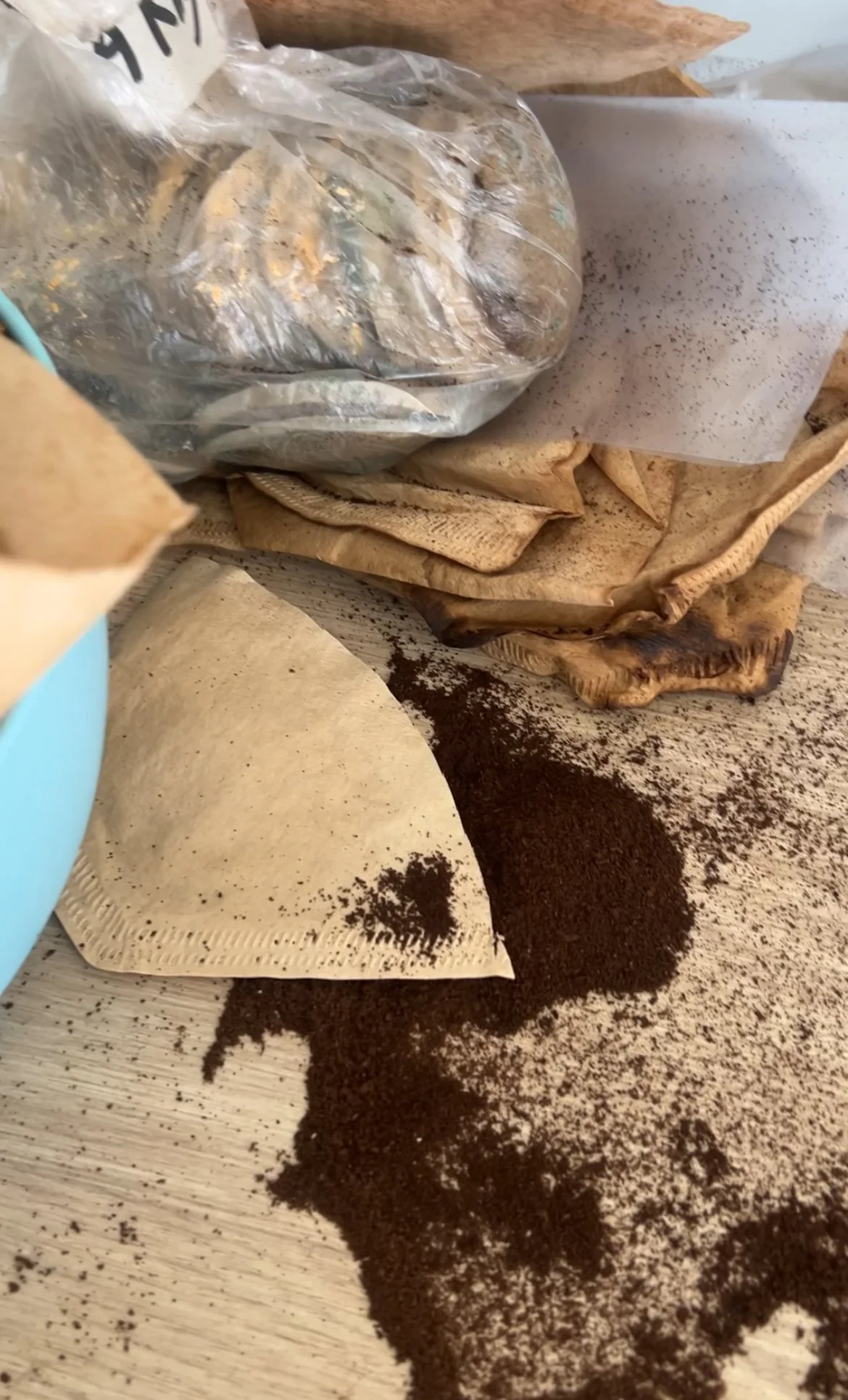
To make circularity physically visible, I wanted to transform the used coffee filters into something unrecognisable from their original state. The idea was to break them down into a fine, grain-like consistency, incorporate that into a moulding paste, and build it onto the canvas as petals. This would be an interpretation of waste becoming something seemingly beautiful.
It didn’t go as planned.
The inconsistent temperatures in the oven caused the filters to catch fire - which was alarming enough in the moment. But when I looked at what remained, the burnt, charred residue of a failed experiment and I couldn’t bring myself to throw it away. In Jamaica, burning garbage is common practice. Not out of carelessness, but due to inadequate waste management systems. That charred layer now sits on the surface of this painting as a record of that reality. It connects Rotterdam and Jamaica through the same unresolved question:
What do we do with what we cannot get rid of?
The answer the painting gives is simple: You transform it
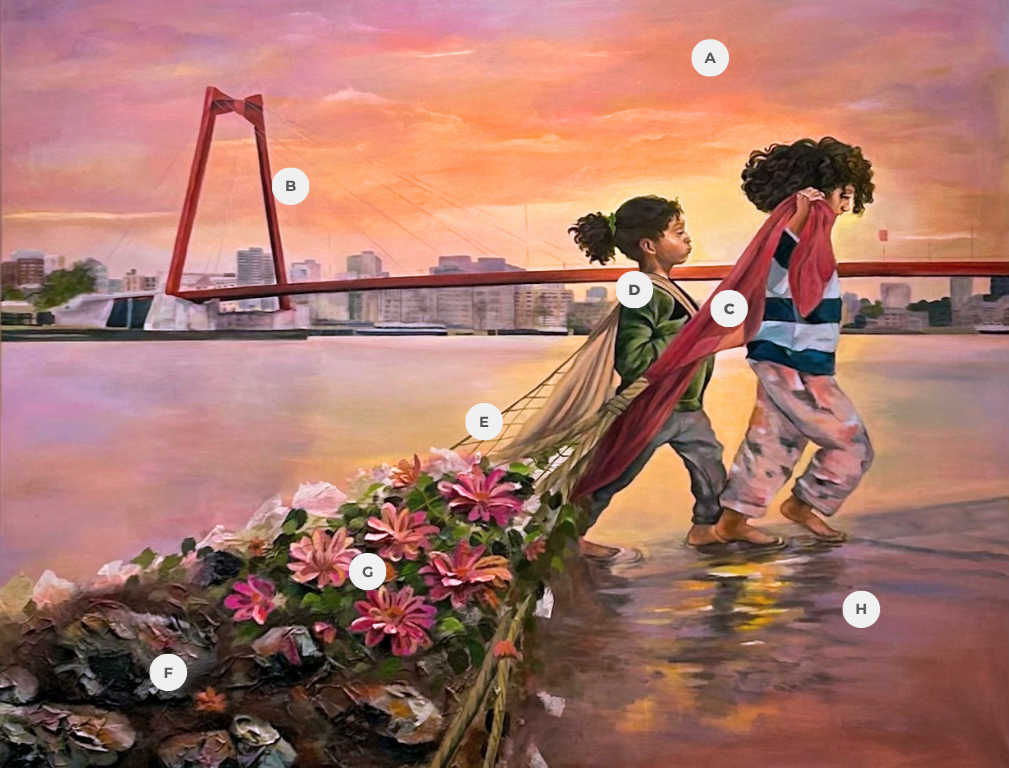
The image shows Fragments of Tomorrow with eight key elements marked A-H. Each annotation corresponds to a marker in the painting.
A | THE SKY: THE DUSK & DAWN OF SOMETHING NEW
The sky exists between dawn and dusk. It holds both simultaneously; not as an ending, but as a transition. Continuity even. The warmth is intentional. I did not want the painting to feel heavy or dystopian, but for it to carry a sense of hope. The kind that comes from believing change is still possible. In the context of sustainability, this space represents something essential: we are not too late, but we are not early either. We are in the middle of it.
B | THE WILLEMSBRUG: SYSTEMS & THE ACT OF BRIDGING
The Willemsbrug connects Noordereiland to the mainland, making it central to both the composition and the story behind the work. But it also became a symbol of something larger. During a conversation with Ellen van Bodegom, the bridge was described as feeling feminine, despite its name, because of its presence and colour. That stayed with me. I began to see the act of bridging as a form of labour: connecting people, holding systems together, and carrying movement forward.
In this painting, the bridge represents the systems that shape our lives. The institutions, infrastructure, and policy and the role they play in building or limiting sustainable futures. But in this context it especially speaks to the collaboration of the governance within the home (the scarf) and that of society, working together to go forward.
c | THE SCARF: REPRESENTATION & RESPONSIBILITY
The pink-red scarf being pulled forward by my son is one I wore to Art Rotterdam the first time I attended as a visitor.It carries memory, but also responsibility. As a parent, I am always aware of what I pass on and so the scarf serves both as the tools and the example. What is held, and what is handed forward. The scarf becomes a thread between generations: a reminder that change is not abstract, it is taught, lived, and carried.
d | THE CHILDREN: THE GENERATION OF NOW
My son appears twice in this painting. Once as he is now and once older, bearing more weight but still moving forward. Representing the generations of tomorrow. The version behind him follows with the same energy. They are dressed simply, in what Jamaicans would call yard clothes: pajamas, house wear. This was deliberate. For them, caring for their environment is not a special occasion or a campaign. It is just what they do routinely and effortlessly because we made it so. That is the aspiration: not a generation burdened by the crisis we created, but one equipped and unafraid to move through it.
e |THE FISHING NET: TOOLS WE ALREADY HAVE
As the scarf extends outward, it transforms into a fishing net, a direct connection to Jamaica, to growing up close to the sea, to the understanding that a net is a tool for pulling something back from where it drifted. Here, the net is not for fish. It is for waste. For pulling back what we have discarded, bringing it into view, It represents the tools we already have to address environmental challenges. It shows it is not something distant or hypothetical, but something within reach, if we choose to use it.
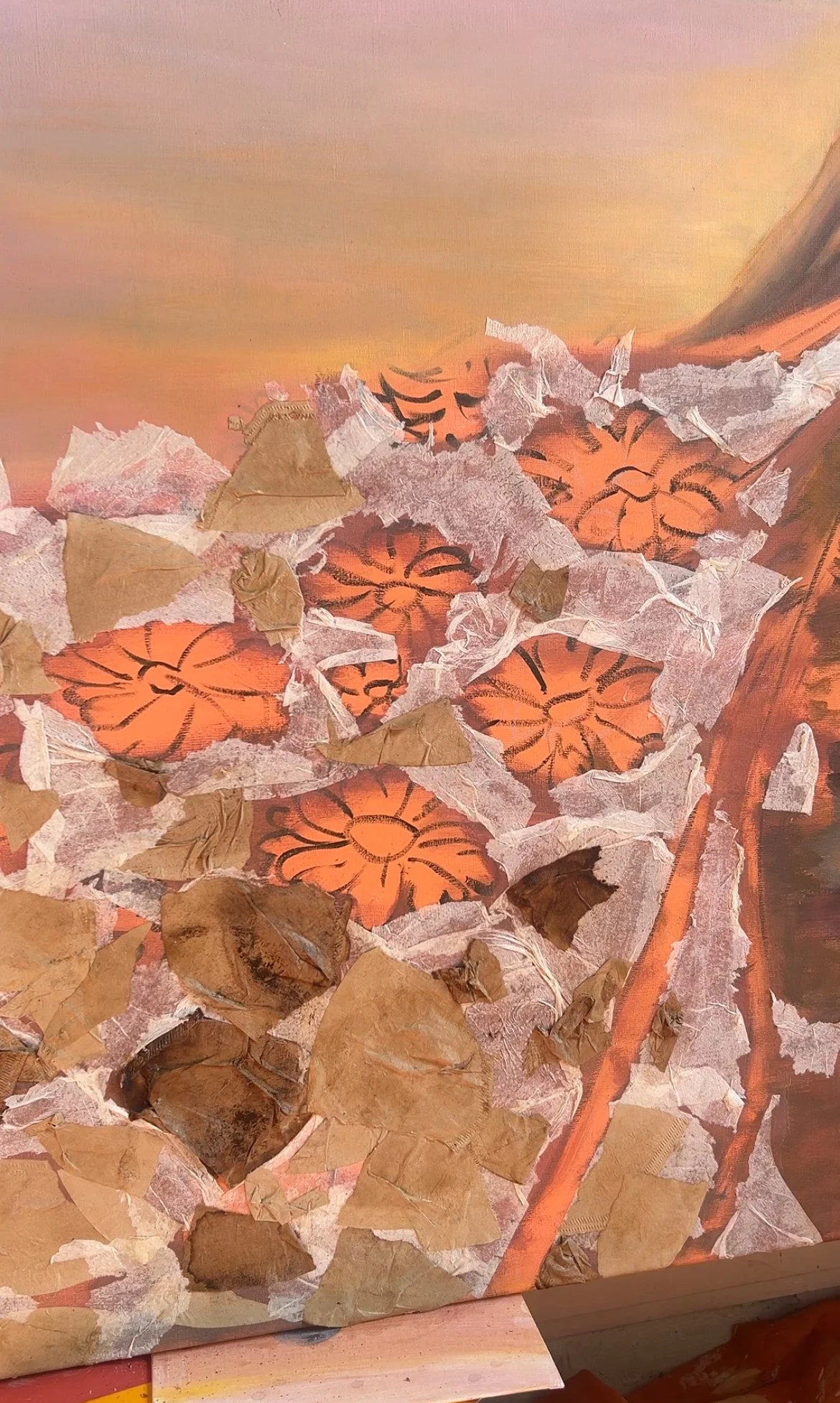
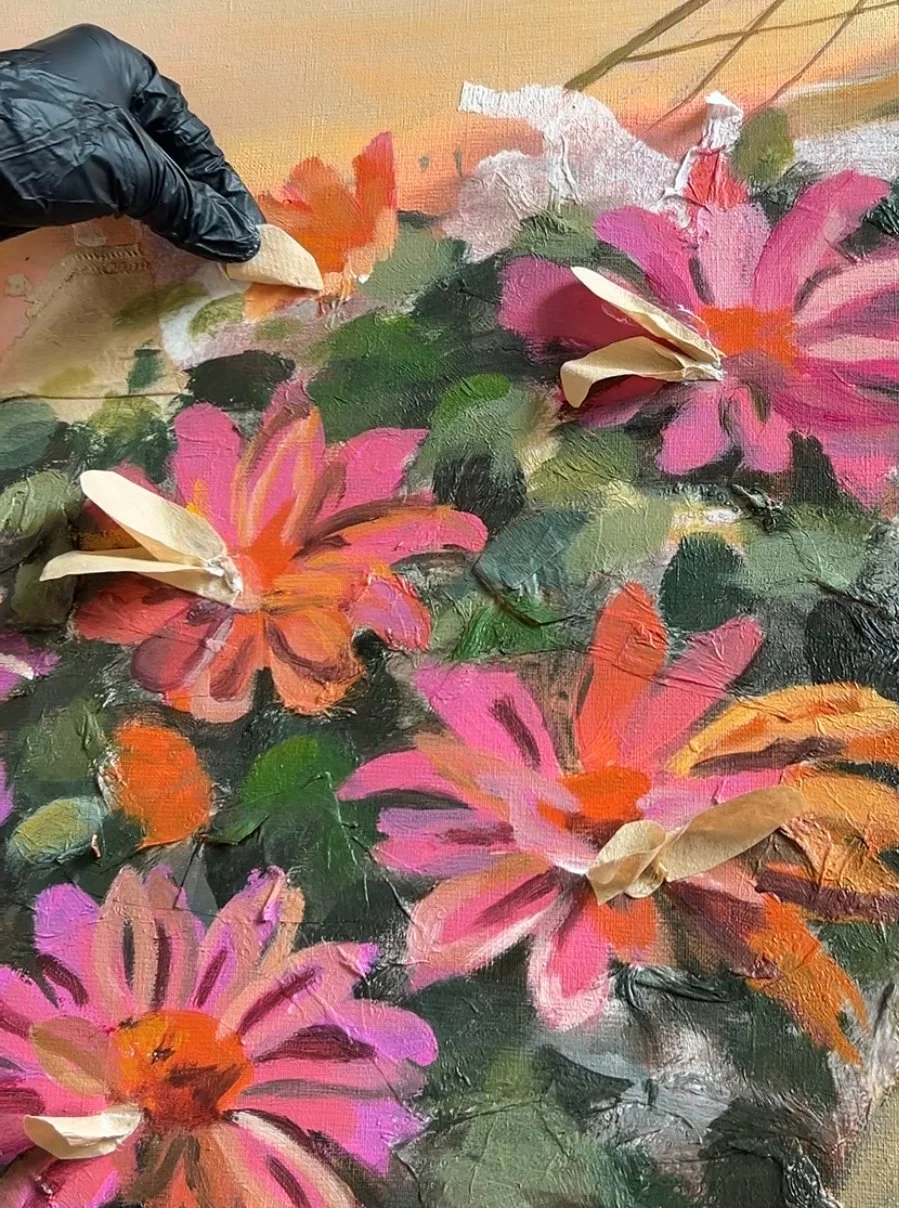
F |The Coffee Filters: Waste as Raw Material
At the base of the canvas, used coffee filters are layered across the surface that were collected from the Noordereiland community, Unprocessed. Unrefined. Exactly as they were discarded. Embedded within this layer are also the burnt remnants from the studio experiment and together they form the foundation for the ‘trash’ element of painting and that of the flowers. Everything begins here: with what we throw away, and what we choose to see in it.
G |THE FLOWERS: FROM WASTE TO SOMETHING SEEMINGLY BEAUTIFUL
Moving upward, the coffee filters are transformed into sculpted, three-dimensional petals. The flowers are the argument made visible, that discarded materials can become something of value when met with intention, and care. For me, flowers have always been one of the first ways I understood beauty. Growing up in Jamaica, surrounded by rainforest, they were everywhere. Unremarkable in the best possible way. Here, they carry both fragility and resilience, and suggest that what is inherited does not have to remain as it was. It can become something else.
H | THE WATER AT THE BASE: THE URGENCY
At the base of the painting, the ground begins to dissolve. Colour fades. Detail disappears. The surface becomes water. The Noordereiland sits outside Rotterdam’s primary flood defences, and residents already experience periodic flooding with worsening conditions over time. This is the urgency within the work. If habits do not change, if systems are not reimagined, if responsibility is not shared…things will disappear. The unfinished section of the painting is not a stylistic decision.
It is a warning.
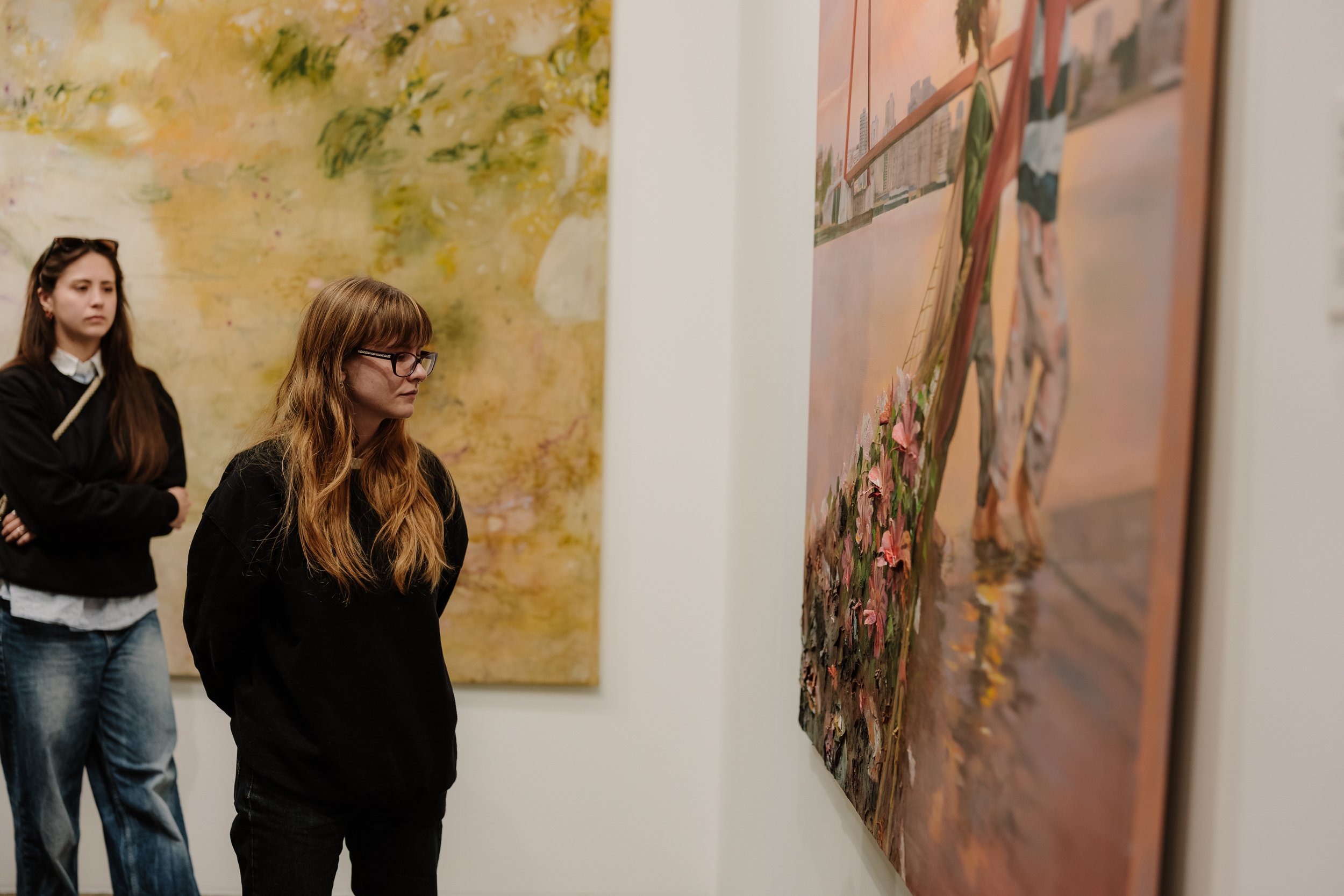
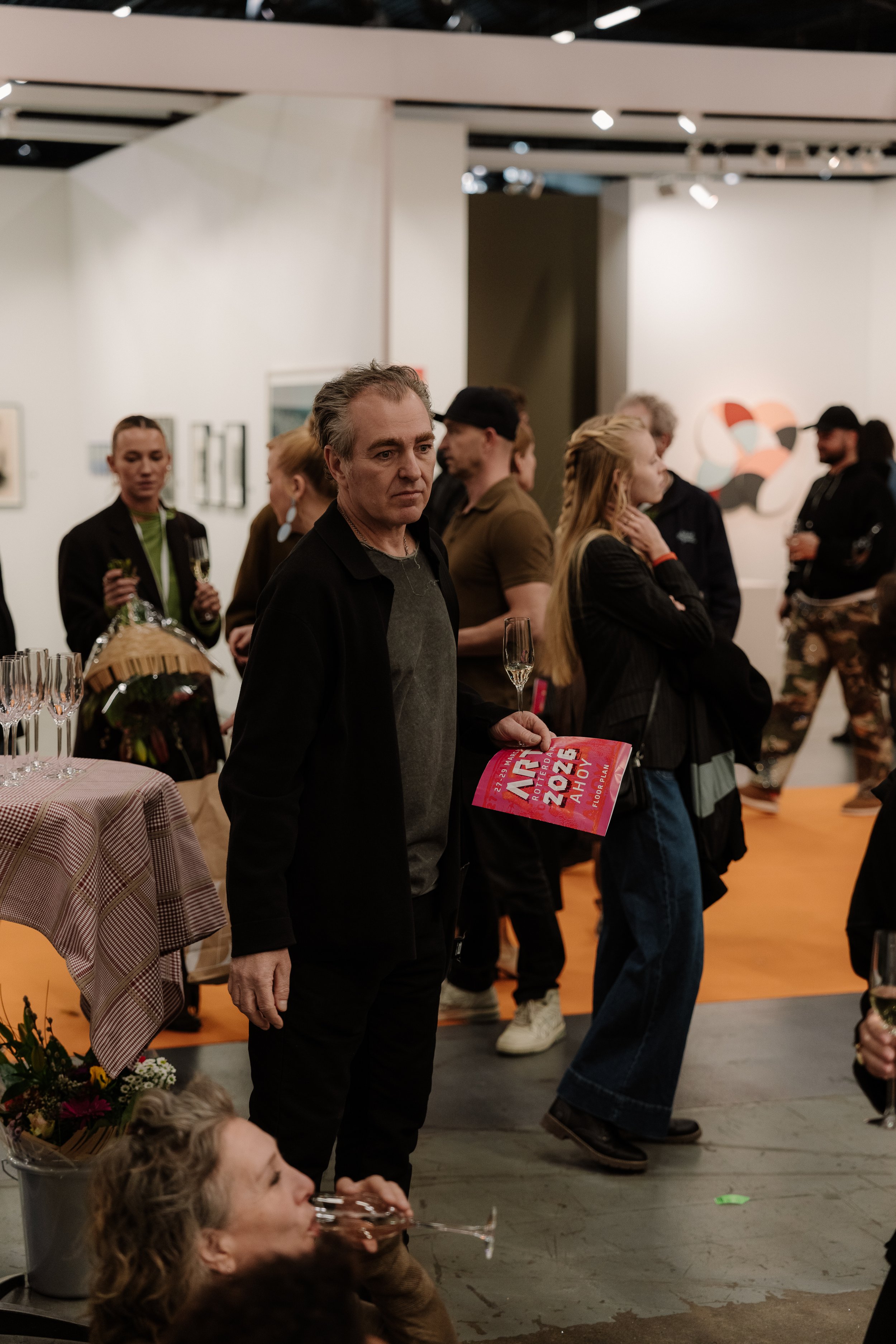
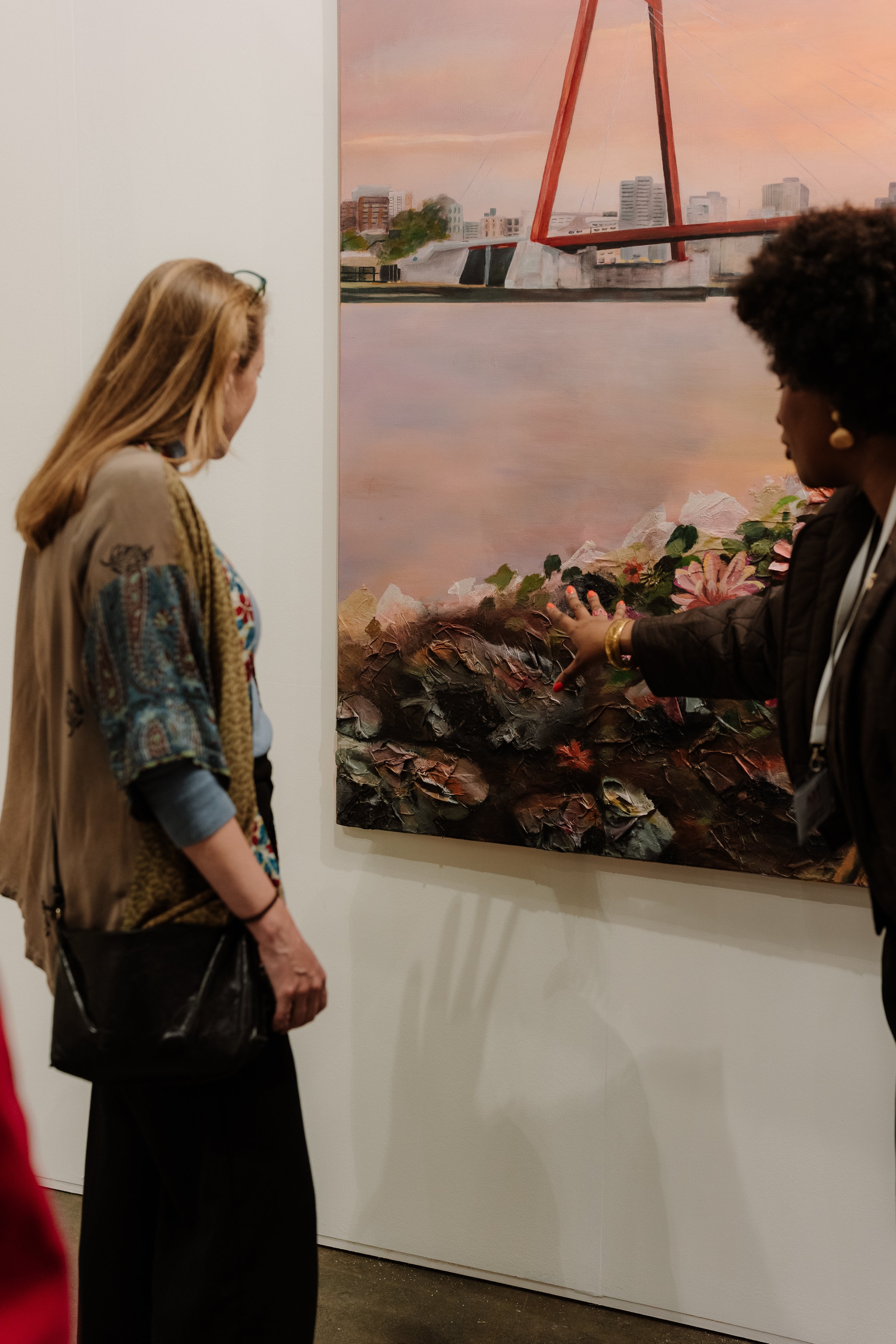
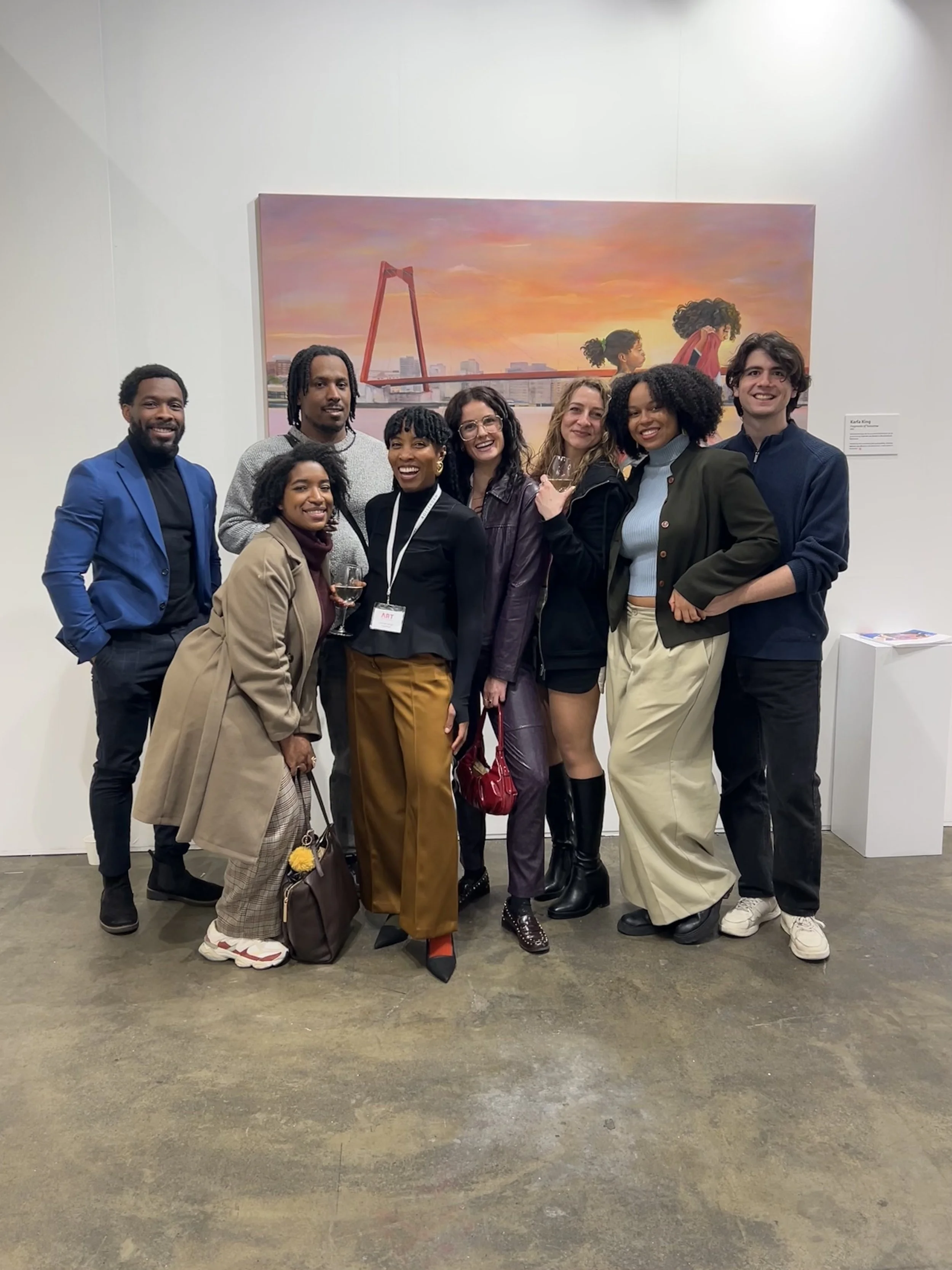
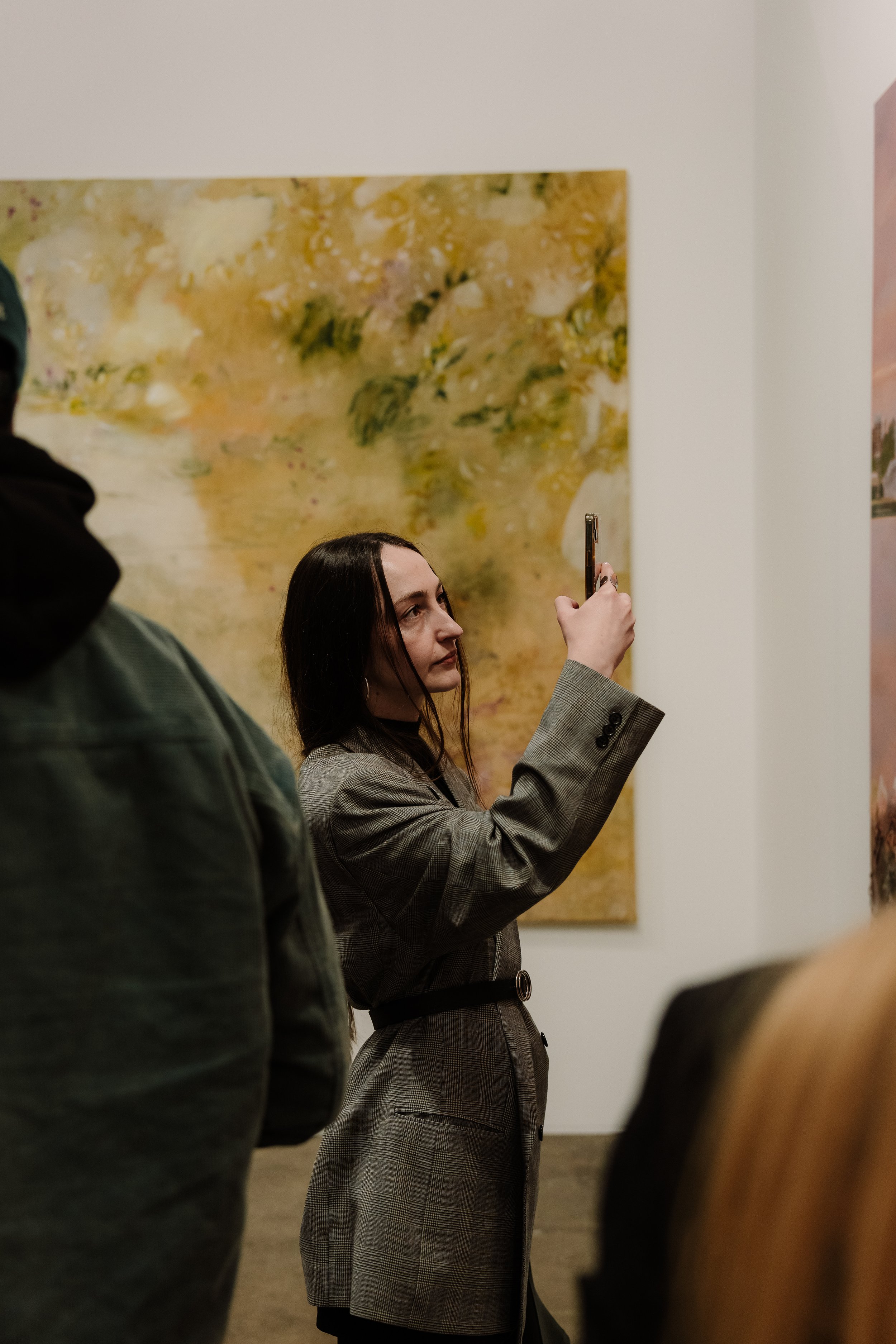
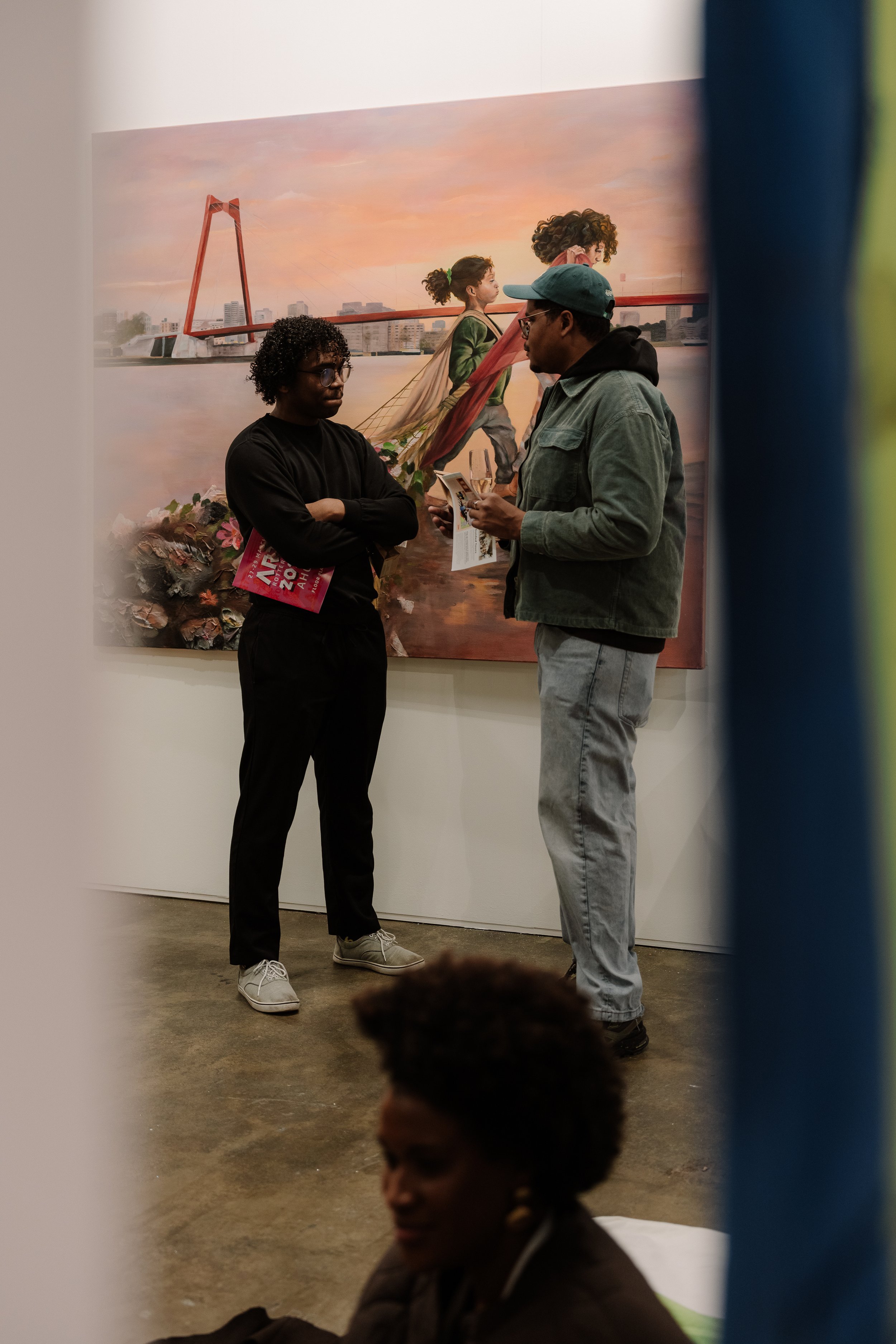
Highlights of South Forward exhibition at DHB Art Space, Art Rotterdam 2026, curated by Unity in Diversity Rotterdam
Why this work matters
Change at the scale we need does not happen through policy alone, or art alone. It happens when institutions, communities, parents, and creatives move in the same direction. Each contributing what they can. What art is uniquely positioned to do is close the gap between knowing and feeling. Most people already know the planet is under pressure. Knowing has not been enough. People act when they feel something. When the abstract becomes personal.
At Art Rotterdam, diversity and purpose driven meaningful art took centre stage the DHB Art Space. People of all stood in front of this painting and saw themselves. Their children. Their neighbourhoods. Their habits. People who had never heard of the Noordereiland, who had no context for Rotterdam South, who had never thought about coffee filters as anything other than rubbish, found themselves in the story. The atmosphere was filled with intrigue and excitement. The shared stories that echoed through exhibition, were saturated in reflection and inspiration.
And for me, this is a sign of what art does when it is working.
At an early age, I learned that nothing is truly waste if you look at it properly, that the most ordinary things can carry meaning if you are willing to see them. A coffee filter is not just a coffee filter. A Friday morning walk is not just a clean-up. A child in yard clothes pulling a scarf is not just a child.
The invitation I’m making is simple. The next time you throw something away, ask whether it has to end there.
The fragments are already here
What we do with them is the question that matters.
SOURCES
1. ICO / Cafely Global Coffee Consumption Data, 2025. verenastreet.com/blogs/all-about-coffee/coffee-statistics
2. Art Rotterdam / DHB Art Space. South Forward, February 2026. artrotterdam.com/2026/02/05/south-forward-in-dhb-art-space
3. Stichting Iedereen aan Boord. iedereenaanboord.nu
4. De Urbanisten. Flood Proof Noordereiland. urbanisten.nl/work/floodproofnoordereiland
Follow the work as it develops
New paintings, upcoming exhibitions, and writing from the studio are shared with the Collectors Circle first. Join here the Newsletter or follow along on Instagram @karlaking_____
